





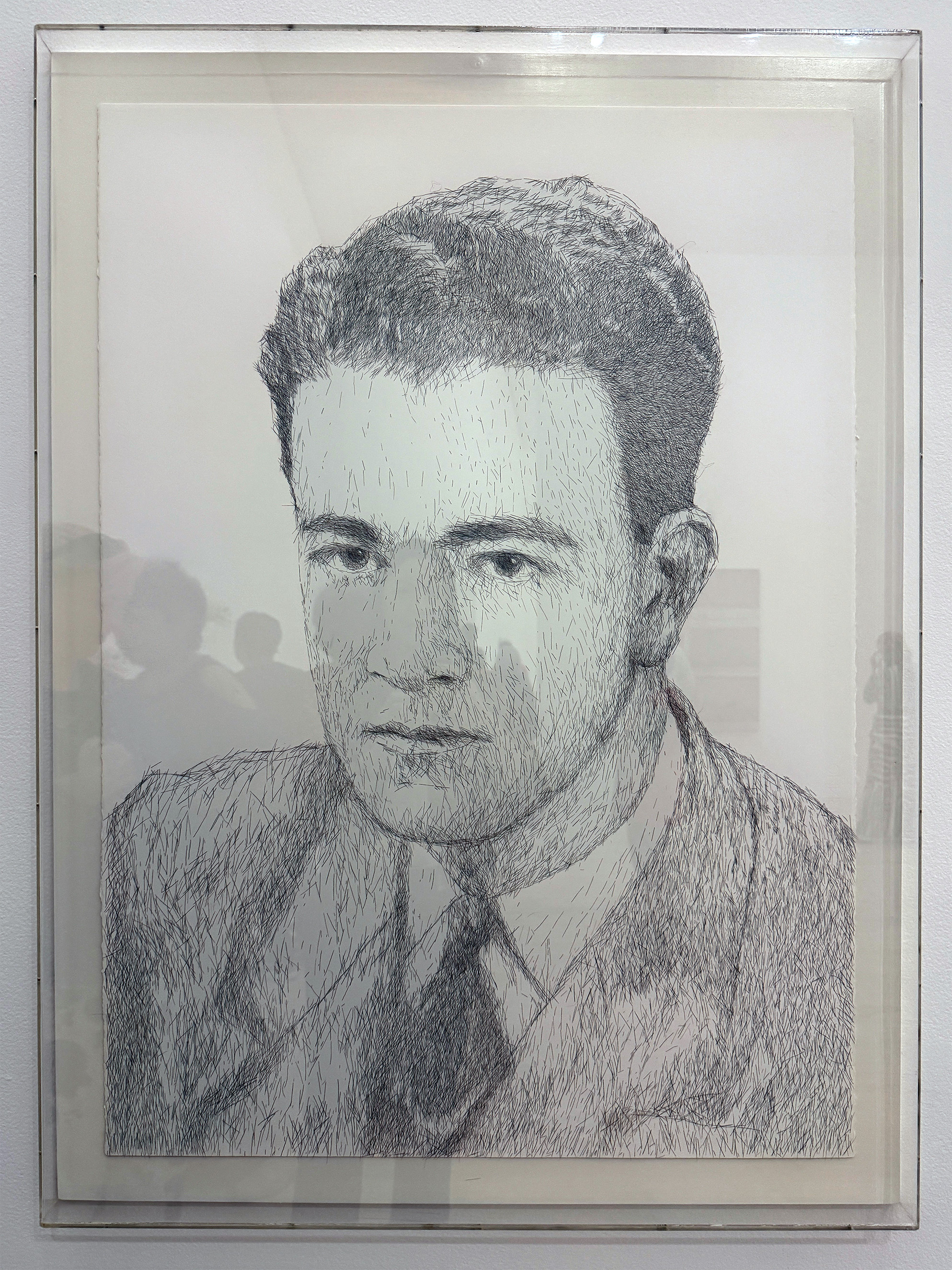
“Oh my gosh, it’s made of HAIR!”
I heard that twice in the few minutes I stood with Gabriel de la Mora’s portrait of his father as a young man. Therefore, by a rough calculation, the phrase is uttered approximately 210 times during Museo Jumex’s normal opening hours (probably in multiple languages).
The portrait is indeed made of hair. Not just any hair, but hair from the exhumed body of its subject, as well as hair from the artist’s deceased sister, other family members, and de la Mora himself.
Gabriel de la Mora: La Petite Mort at Mexico City’s Museo Jumex is a thematic survey of the artist’s practice over the past 20 years. The artist is known for his transformation of materials through decay, degradation, fire, water, time, and other elemental forces to create exquisite objects and alluring surfaces. Those processes can be highly crafted, such as the careful dissection and mounting of butterfly wings or human hair set into geometric compositions, or the painstaking reclamation of historic, weathered ceilings onto canvas. They may equally be the result of elemental forces that react with and erode paintings, prints and papers to the edge of degradation.
The obsession with death and decay is far from morbid, however. The painstaking detail of de la Mora’s work counterbalances the violence. The obsessive precision of his work exerts control over nature and frames the decay as an artistic collaborator rather than something to have a knee-jerk grossed out reaction to.
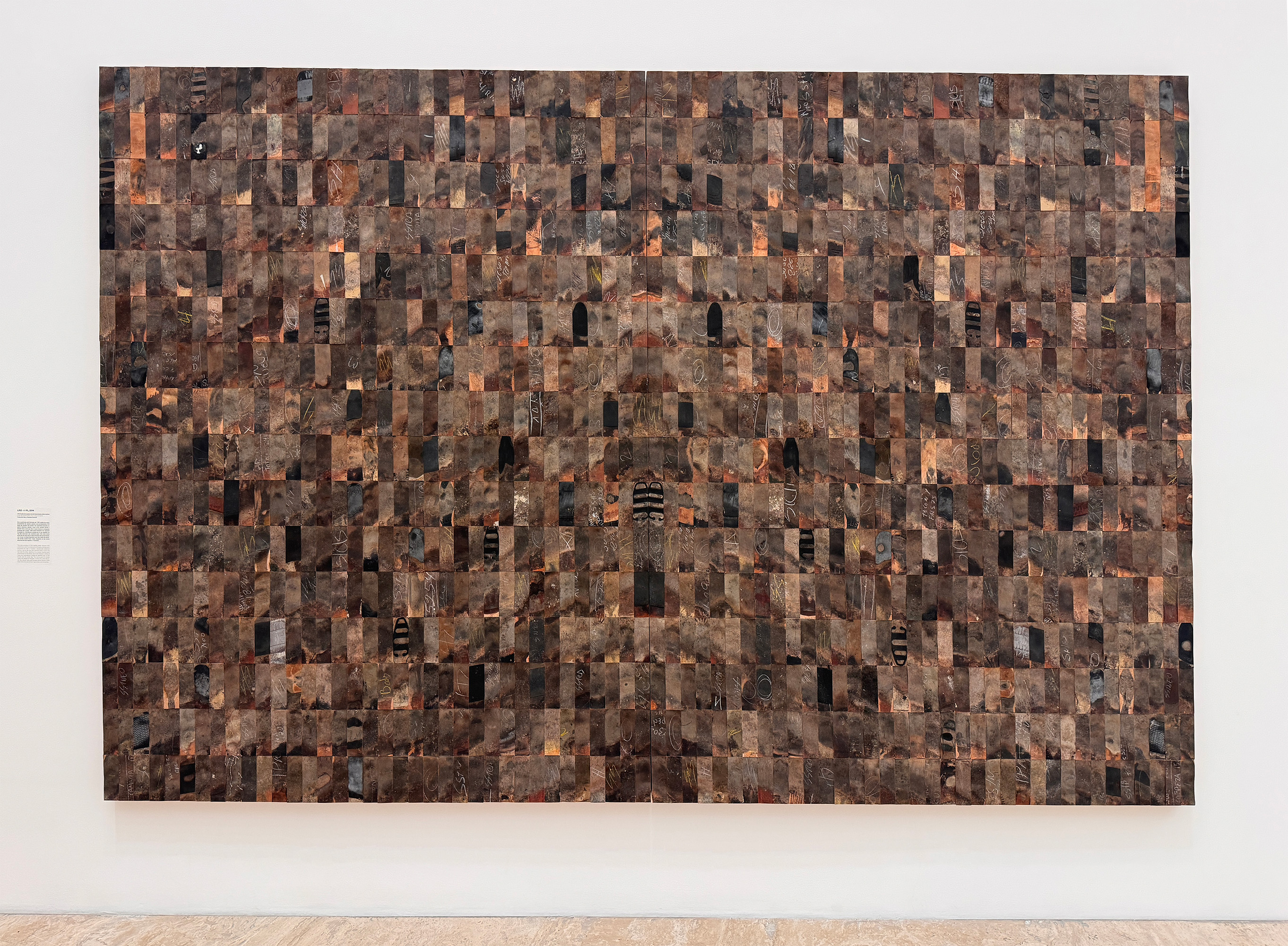
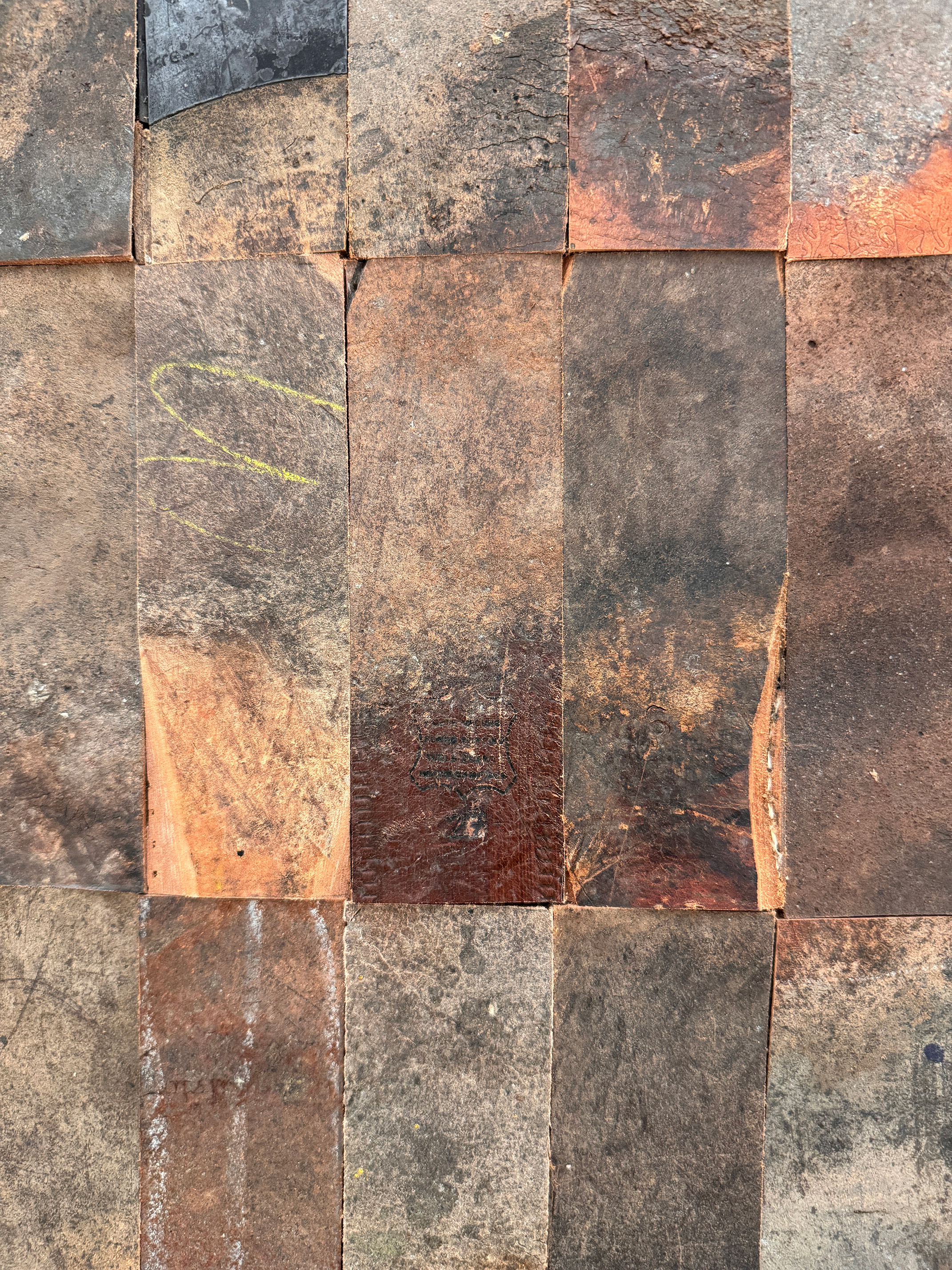
For Gabriel de la Mora the artwork already exists before the artist, and therefore it is not his role to either create or destroy, but merely to present.
His series composed entirely of butterfly wings is presented alongside a newer body of works made of obsidian shards. The regular sequence of the square painting-without-paint is rather animated with both color and movement. Each work is a parade of fragments, meticulously combined into organized geometrical compositions following the chromatic palette of the organic and inorganic specimens employed.
The electric blues, citrines, ruby and emerald iridescences of the butterfly wings are alternated to the reflective shades of blacks and grays of the obsidian, resulting in mosaics and chessboards between figuration and abstraction. Their making needs extreme care and a prolonged time — from the ethical sourcing of the materials to their surgical cutting and their cataloguing — leading to the final configurations. The titles unveil an analogous precision, as their archivist style indicates both the number of fragments (up to 2,876) and the species used.
Gabriel de La Mora’s practice of collecting, fragmenting and organizing organic and inorganic materials is well-known. Egg shells, feathers, shoes soles and speaker covers are just a couple of examples. If in the past the focus has been on mundane materials, the new works acquire existential notes.

That energy which distinguishes living bodies, as Henri Bergson would put it. That intrinsic repetition denoting the works could then be interpreted as an attempt to dissect entropy, while embracing the beauty of its ineffability.
Despite their scientific character, in fact, Gabriel de La Mora’s paintings convey a sense of wonder. Repetition is looked at as extraordinary, almost magical – an operation acting on the mundane to generate the unforeseen, in hallucinatory compositions.